

(wait, no…I mean, quirky)
For music – as with all artistic pursuits – the boundaries of convention are meant to be tested. Post-war avant-garde composer, John Cage, wrote a piece consisting of four-and-a-half minutes in which no one plays a note. He also stuck screws and bolts between the strings of the piano to make music like this:
People like Peter Schat took things a bit further with pieces like To You – written for the spectacular line-up of soprano, six guitars, three bass guitars, four pianos, two organs and, of course, man-sized humming tops:
Richard Thompson had a quick foray into Okinawan folk music – which became the greatest chair-spinning song of all-time (at least in my house:)
But composers had been getting weird centuries before Cage, Schat and Thompson. One weirdo in particular really stands out to me: the enigmatic 19th Century French composer, Erik Satie.
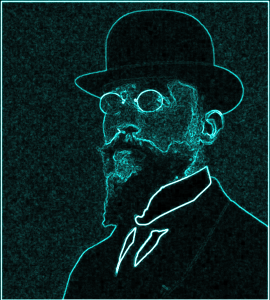
In the ad world, we don’t often get asked to compose something ‘weird’ – but we do get asked to go ‘QUIRKY.’ Whatever that difference is, I now think Satie figured it out first.
He was a quirky dude: eating only foods that were white in colour, carrying a hammer wherever he went, writing a piece of music with the instruction to repeat it 840 times. He’s even credited with inventing Muzak (something he called, “furniture music.”)
But he was also able to take something very familiar, very simple – and tweak it in his inimitable way to give us something wholly original…and his type of weird.
One of his most famous examples of this is a piece for solo piano called Gnossienne No 1. It’s got a very familiar, very simple bass-and-chords pattern in the left hand. But on top of this foundation is where Satie finds inventive, intriguing spaces to explore, float around and…get weird. Not only weird – but ‘exotic.’
The genius of Gnossienne No 1 was that all he had to do was change one note of a very familiar scale – and base the whole piece on it:
(In the process, he invented what we now call the ‘Satie scale.’)
With just that one altered note comes completely altered expectations on the part of the listener. Without knowing how or why, we’re hooked on a melody that circles around without definitive direction, hanging there in a dreamy, vague, exotic sonic limbo.
And so it became the perfect fit for Jon Hamm and ‘Shouldda Skipped It’ – as we got to reinterpret the Gnossienne 134 years after it was first published.
The spot has elements of the surreal – blending humour and relatability. It encourages us to skip the mundane – but do it nice n’ easy. Being a dialogue-heavy spot, our music had to float in the background. In that background, we got to be weird, but not too weird. Dare I say…quirky?
 THE EARWORM
Leave a comment