
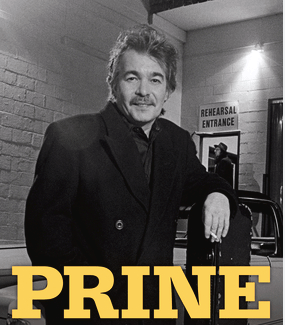
How the hell can a person / go to work in the morning / then come home in the evening / and have nothing to say?
Has there ever been a better way to distill abject monotony? And how on earth does a 25-year-old, with no song writing experience, capture the point-of-view of a middle-aged woman in a thankless marriage? That’s the genius of John Prine, one of Bob Dylan’s favourite songwriters.
John’s hits span five full decades – and no one writes like him. There’s got to be an innate gift there. But when prodded, he did give tangible advice and techniques – a lot of which can be found in Holly Gleason’s new book, Prine on Prine.
Prine had no qualms about writing from a woman’s point of view. “If you come up with a strong enough character, you can get really vivid insight into the character you’ve invented. You let the character write the song.” Prine said it all started with an image of a woman with soapsuds on her hands. She lived in Montgomery, Alabama and wanted to get the hell out of there. That’s it. Cue: Angel from Montgomery.

Prine was big on details – but not the ones you might think: “the more the listener can contribute to the song, the better. Rather than tell them everything, you save your details for things that exist. Like what color the ashtray is. So when you’re talking about intangible things, like emotions, the listener can fill in the blanks.” Big concepts get their impact as something experienced – through details that produce vivid images.
On that same debut album, Prine has his most famous protest song, Sam Stone – also awash in details. No political statements, though. Instead we get the personal story of one man coming home from Vietnam.
Sam Stone came home to his wife and family / after serving in the conflict overseas / and the time that he served had shattered all his nerves / and left a little shrapnel in his knees
Having just re-watched The Hurt Locker, it got me thinking about a connection there. The film is really only about the characters, their thoughts, actions, motivations, stories. Like Sam Stone, it lets the atrocities of war reveal themselves without telling me how to feel. The reliance on the imagination of the audience – a Prine hallmark – lets the individual story carry the broader message.
He does it again later on the album with Donald and Lydia. Here, we experience a timeless story of loneliness directly through two people who are too shy to even introduce themselves; forced to meet only in their dreams.
Lydia hid her thoughts like a cat / Behind her small eyes sunk deep in her fat / She read romance magazines up in her room / and felt just like Sunday on Saturday afternoon
The verses are poignantly micro, while the chorus goes macro. John explains: “As far as telling a story and having the chorus be the moral to the story. A wider moral than what the story is saying. Like where the chorus is all-consuming, a much bigger subject than what you’re detailing.”
When John died due to complications from Covid, I found myself missing him. I wanted his honesty, and his take on the state of the world. So, the first song I wrote during the pandemic was in tribute to him. I took some of his advice – starting specifically with thoughts of John, then onto the perils of solitude and finding more meaning in life.
Though the light peeks through sometimes / the picture remains unclear / I think I know who god is, just not who he’s for / and why he put me here
Another reason ‘Where are you John Prine?’ means so much to me is all the people who brought it to life. It started with my brothers in the band, and then grew to include the incomparable Renee Rowe on vocals. Her voice brings so much meaning and spirituality, you can’t help but feel every note (even every head nod.) We then roped in the country’s greatest guitar player – and Norah Jones collaborator – Kevin Breit, to make the solo sing as soulfully as Renee. Add in Eggplant’s own Nathan Handy and Peter Pacey to mix and master, and you’ve got the full picture of the family together for one heartfelt track. Check it out.
 THE EARWORM
Leave a comment